


By Serena Roman ·
Somewhere in a cypress slough in Collier County, a leafless orchid clings to a pond apple trunk by nothing but gray-green roots. For most of the year you'd walk right past it. Then, some summer night, a white flower with two long, curling tails opens and waits for a sphinx moth. That's the ghost orchid, the most famous of Florida's native orchids, but it's far from the only one.
Florida has more wild orchids than any other state in the continental US. Some grow a stone's throw from I-75, and a few have been gone for half a century. This guide covers the epiphytes, the terrestrials, the rare and the lost, and one delicate species you can grow on your own lanai.
How Many Orchids Are Native to Florida?
Florida is home to roughly 106–118 native orchid species and varieties, depending on who is counting and how. That's about half of the orchid species found in the continental United States (Fairchild Tropical Botanic Garden).
The counts differ because botanists disagree about taxonomy, not about the plants themselves:
- At least 106 native species: UF/IFAS, citing the Atlas of Florida Plants.
- 117 species and varieties: Paul Martin Brown's Wild Orchids of Florida.
- 121 accepted taxa in total: the Atlas of Florida Plants. This figure includes varieties and naturalized non-natives.
What everyone agrees on is how precarious they are. According to UF/IFAS, 58 Florida orchids are listed as state Endangered and 18 as Threatened, and the Naples Botanical Garden puts the share of imperiled native orchids at about 70%. Most of the diversity sits in South Florida. The Fakahatchee Strand Preserve State Park, often called the orchid capital of North America, holds 47 orchid species by itself, about half of them epiphytes (Friends of Fakahatchee).
Florida Orchids at a Glance
~106–118 native species · 58 state Endangered · 18 state Threatened · 47 species in the Fakahatchee alone · 1 globally extinct
Where Florida's Orchids Live
To understand these plants, look at where they grow. Florida's natives fall into a few distinct communities:
- Cypress strands and sloughs. The Fakahatchee, Big Cypress and Corkscrew Swamp. Standing water under a closed canopy keeps the air humid and buffers winter cold. This is epiphyte heaven.
- Tropical hardwood hammocks. Islands of West Indian trees on slightly higher ground in Miami-Dade, the Keys and the Everglades, and home to many of the rarest species.
- Pine rocklands, flatwoods and scrub. Sunny, fire-shaped habitats for terrestrials and a few tough epiphytes.
- Mangroves and buttonwood. Salt-tolerant specialists like the mule-ear orchid.
- Bogs, seeps and wet prairies. The kingdom of the grass-pinks, fringed orchids and ladies'-tresses, reaching well into North and Central Florida.
If you grow orchids in Florida, you already know these conditions from your own bench: humid summers, dry winters, and the occasional cold snap that decides everything.
Florida's Epiphytic Orchids
These are the tree-dwellers. Most are tropical species at the northern edge of their range, and Florida is the only place in the continental US where most of them grow.
Tampa Butterfly Orchid (Encyclia tampensis)
Commercially Exploited
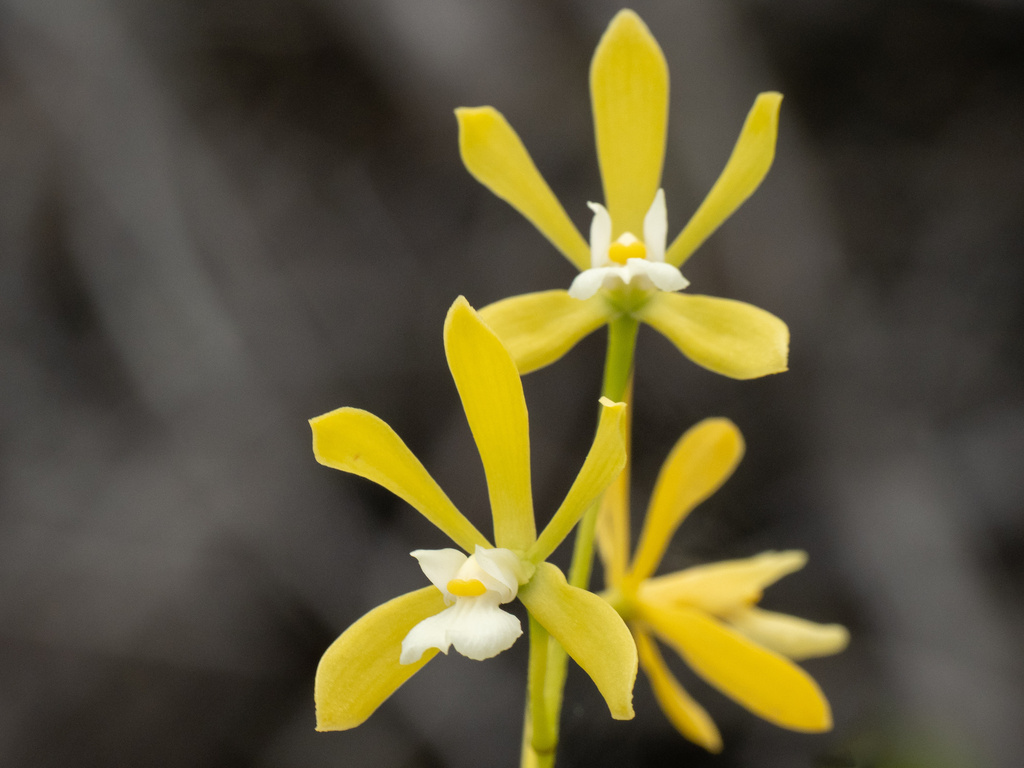
Photo: © Turner Brockman, CC BY-SA, via iNaturalist
Florida's everyday epiphyte and the one most people see first: grape-sized pseudobulbs clustered on live oaks and cypress, with fragrant greenish-brown flowers and a white, magenta-marked lip from May through August. It is one of the most common epiphytic orchids in the state (FNAI), yet it is listed as Commercially Exploited by the Florida Department of Agriculture and Consumer Services (FDACS) because it was collected so heavily.
Green-Fly Orchid (Epidendrum magnoliae)
Commercially Exploited
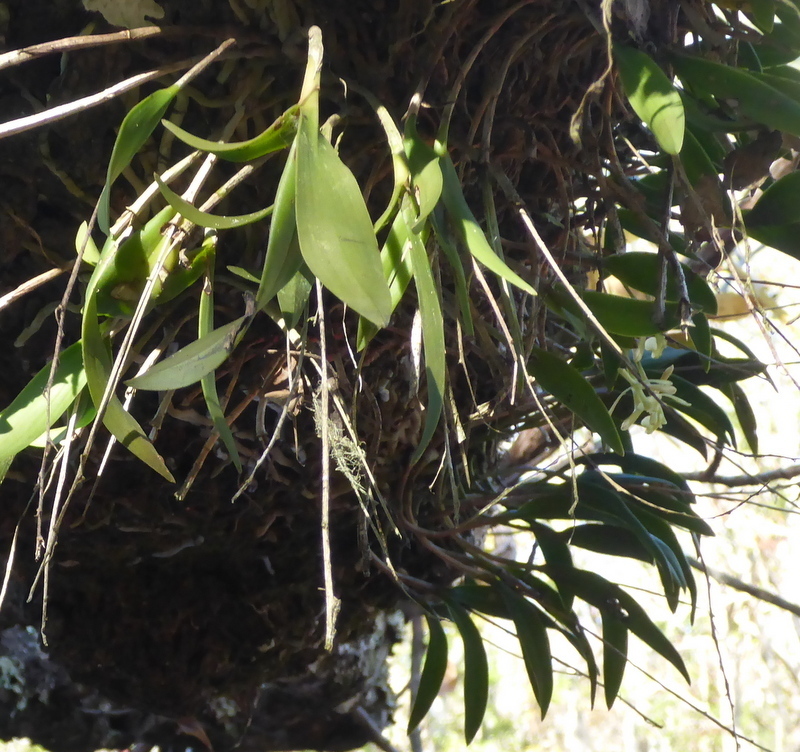
Photo: © mfeaver, CC BY, via iNaturalist
The explorer of the group. It grows on live oaks and magnolias as far north as North Carolina, making it the only epiphytic orchid in the eastern US that ranges well beyond Florida (Go Orchids). Small green flowers appear from late summer into winter and are fragrant at night. You'll still see it listed under its old name, E. conopseum, including in the FDACS rule.
Clamshell Orchid (Prosthechea cochleata var. triandra)
State Endangered
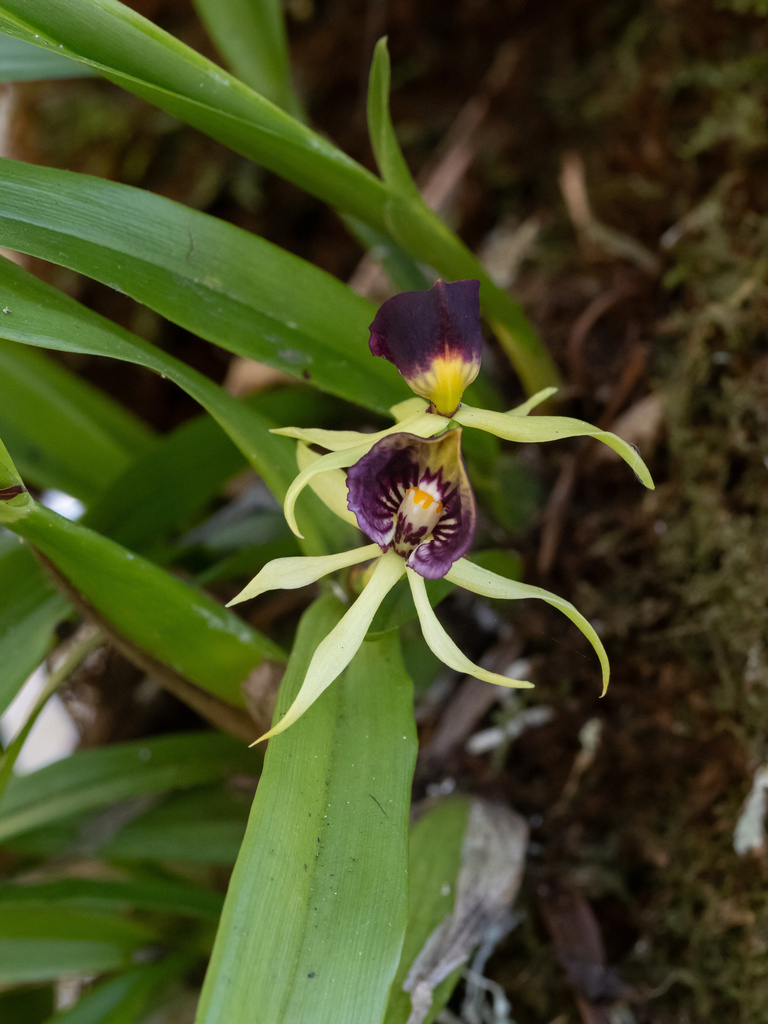
Photo: © Turner Brockman, CC BY-SA, via iNaturalist
Its upside-down, purple-black clamshell lip makes it instantly recognizable. Florida's plants belong to a distinct variety with three anthers instead of one, and they pollinate themselves (Go Orchids).
Cigar Orchid (Cyrtopodium punctatum)
State Endangered
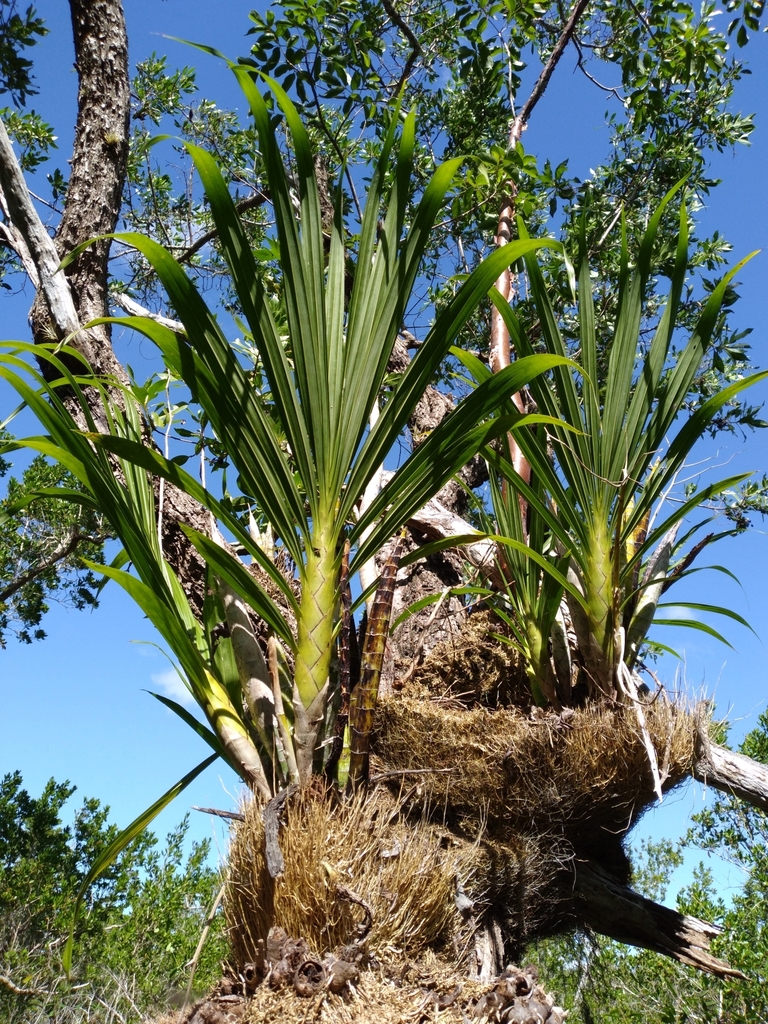
Photo: © Scott Ward, CC BY, via iNaturalist
Pseudobulbs like fat cigars and explosive spring sprays of yellow, red-spotted flowers. This is not a subtle plant. Clumps can reach 1.5 m, and oil-collecting Centris bees pollinate it (Go Orchids). It is also the poster child for what collecting did to Florida's orchids: UF/IFAS lists it as endangered "due to poaching," and it was once stripped from South Florida hammocks by the truckload.
Florida Oncidium (Oncidium ensatum)
State Endangered
A big, grassy-leaved Oncidium that often roots at the base of cypress and in leaf litter rather than high in the canopy. Tall sprays of yellow-brown flowers appear between April and September. The FDACS list still carries it as O. floridanum.
Bahama Dancing-Lady (Tolumnia bahamensis)
State Endangered · Globally Vulnerable
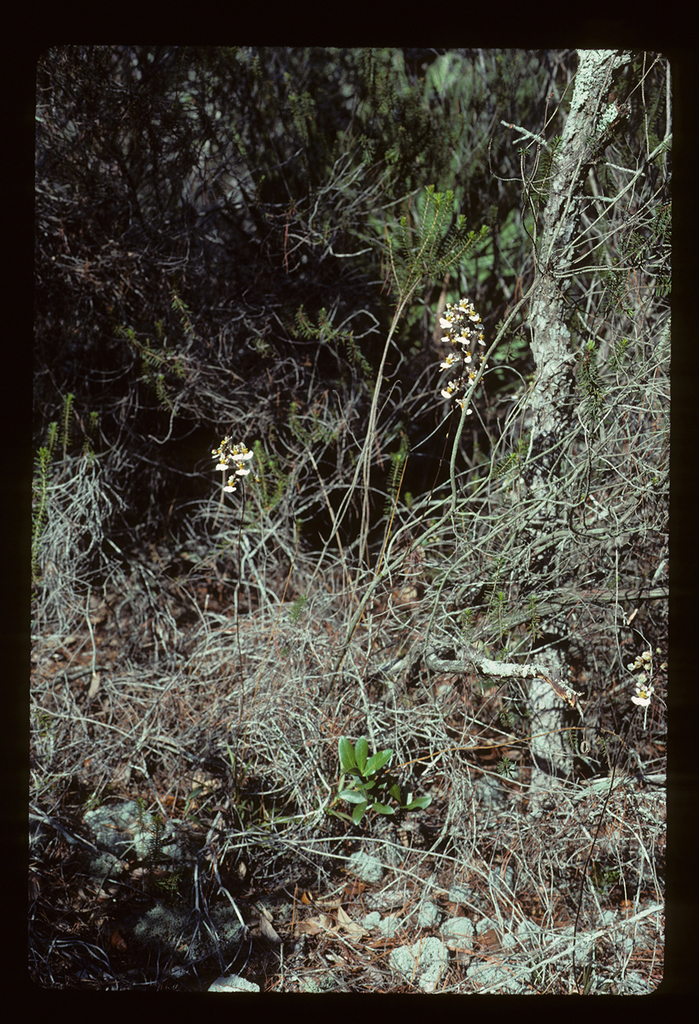
Photo: © Douglas Goldman, CC BY-SA, via iNaturalist
A tiny fan-leaved orchid of southeast Florida's coastal scrub that throws up bright yellow "dancing ladies" in April and May. Coastal development has taken most of its habitat, and lab-raised seedlings are now being reintroduced (Go Orchids).
Mule-Ear Orchid (Trichocentrum undulatum)
State Endangered
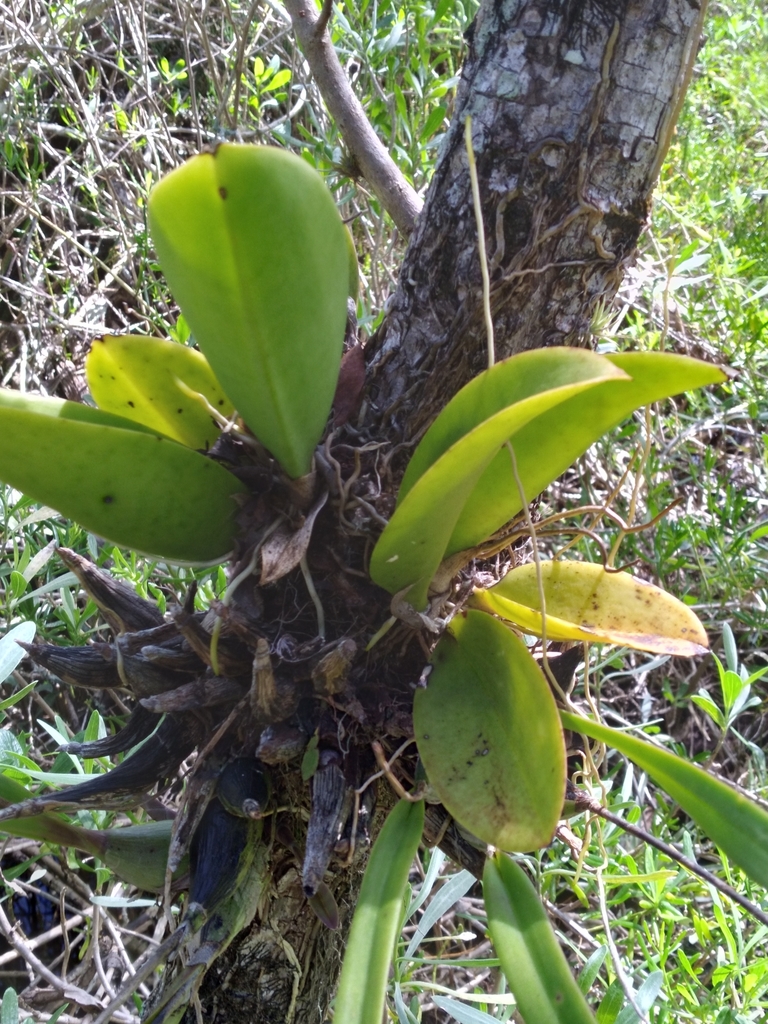
Photo: © Scott Ward, CC BY, via iNaturalist
Thick, leathery leaves shaped like a mule's ear, growing on buttonwood and mangrove. Florida holds a single US population, in Everglades National Park. Invasive scale insects and then Hurricane Irma in 2017 hit it hard, and Florida International University researchers are now working to restore it.
Night-Scented Orchid (Epidendrum nocturnum)
State Endangered
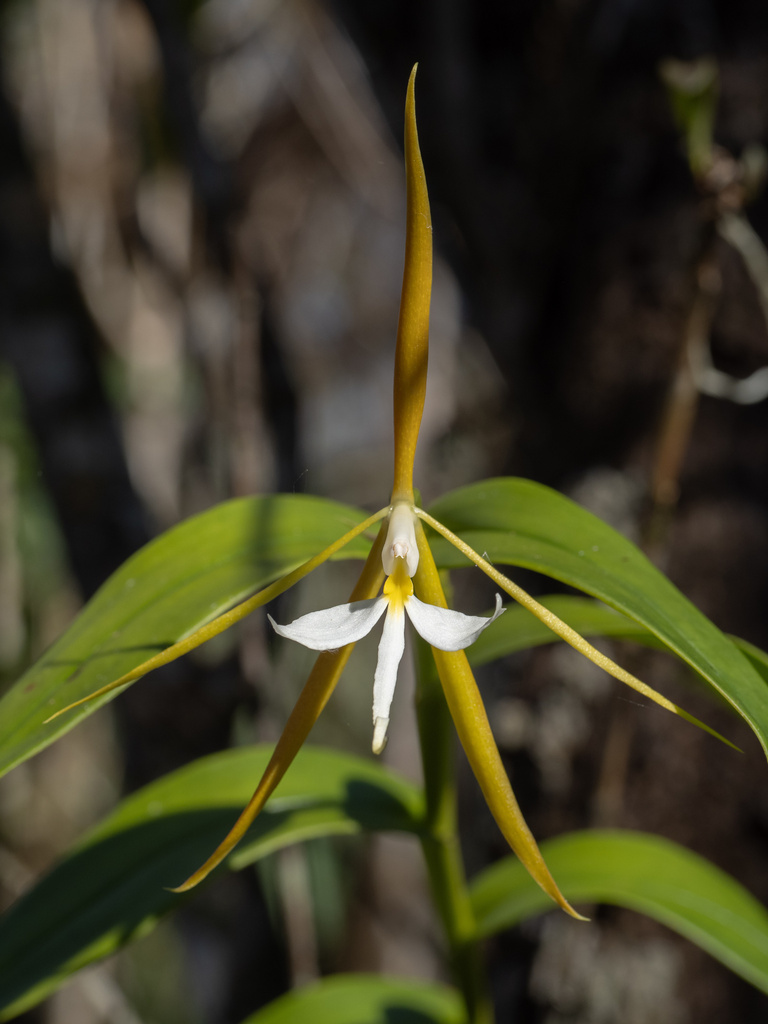
Photo: © Turner Brockman, CC BY-SA, via iNaturalist
A lanky plant with spidery white flowers, fragrant after dark for any moth that might come by. In practice it often pollinates itself inside buds that never fully open.
Jingle Bell Orchid (Dendrophylax porrectus)
State Threatened
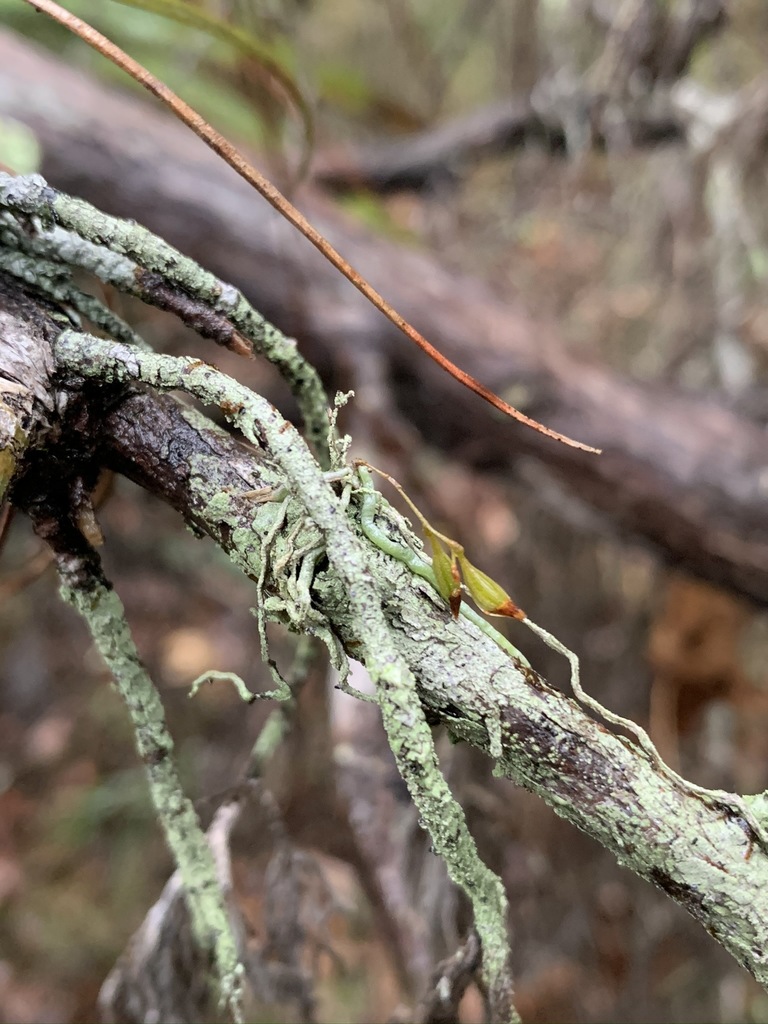
Photo: © Brandon Corder, CC BY, via iNaturalist
If you've spotted this one, you have sharp eyes. It's leafless, all roots, and its flowers are 2–3 mm across. Older references file it as Harrisella porrecta.
Ghost Orchid (Dendrophylax lindenii)
Proposed Federally Endangered
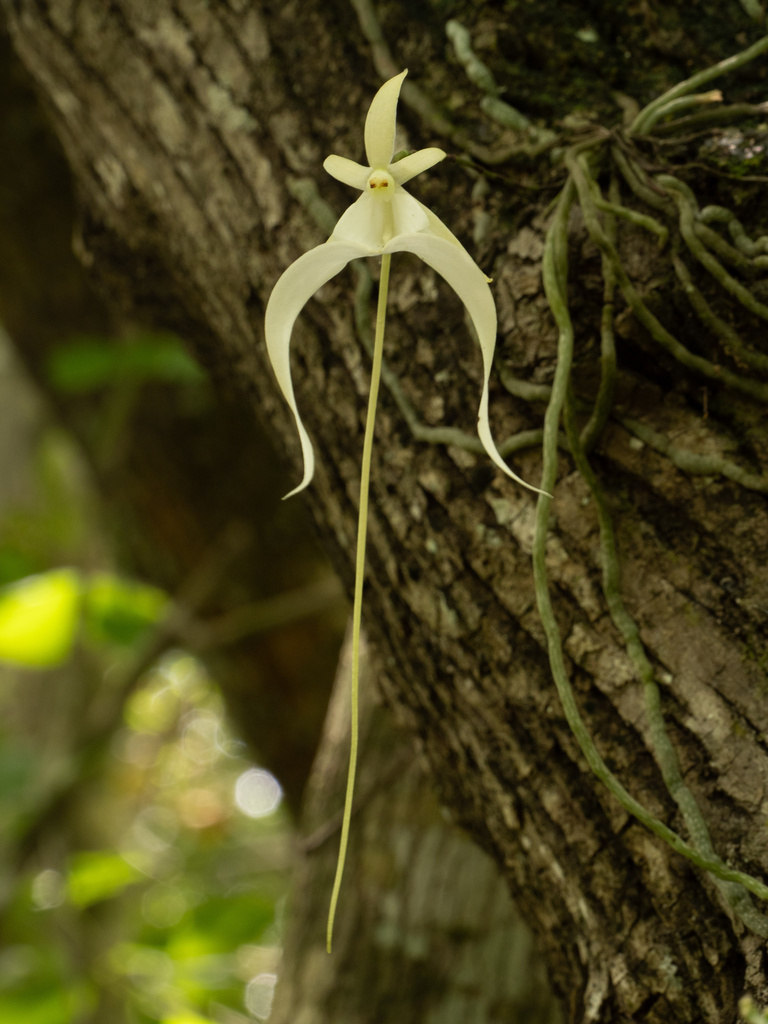
Photo: © Turner Brockman, CC BY-SA, via iNaturalist
Florida's most famous orchid has no leaves at all. It photosynthesizes through its roots, flowers from May through August, and grows mainly on pop ash and pond apple in the swamps of Collier and Hendry counties. It is slow, too: roughly 15 years or more to mature, according to the US Fish and Wildlife Service (USFWS).
Camera traps at Corkscrew Swamp confirmed that the fig sphinx moth (Pachylia ficus) carries its pollinia. The giant sphinx, long assumed to be the pollinator, visited flowers but never removed a pollinium (Houlihan et al., 2019). In June 2025, USFWS proposed listing the ghost orchid as federally Endangered, counting fewer than 1,000 plants in the US, less than half of them mature. As of this writing the final decision is still pending, and USFWS chose not to publish critical habitat maps because they could help poachers.
Ghost Orchid Field Notes
- Leaves: none. The roots do the photosynthesis.
- Blooms: May–August in Florida
- Hosts: mainly pop ash and pond apple
- Pollinator: fig sphinx moth (Pachylia ficus), confirmed 2019
- US population: fewer than 1,000 plants (USFWS, 2025)
Florida's Native Vanillas
State Endangered
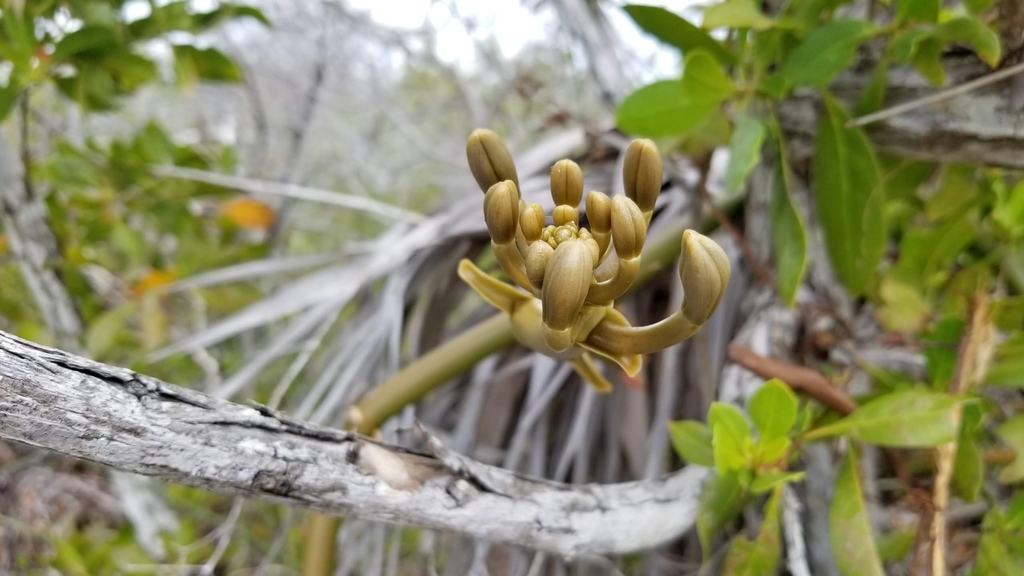
Photo: © Michelle Sevcovas, CC BY, via iNaturalist
Yes, Florida has wild vanilla. Four species appear on the state Endangered list: Vanilla barbellata, V. dilloniana, V. mexicana and V. phaeantha (FDACS). The leafless V. barbellata still hangs on in the Keys and South Florida. V. dilloniana hasn't been so lucky; you'll find it in the lost-orchids section below.
Delicate Ionopsis (Ionopsis utricularioides)
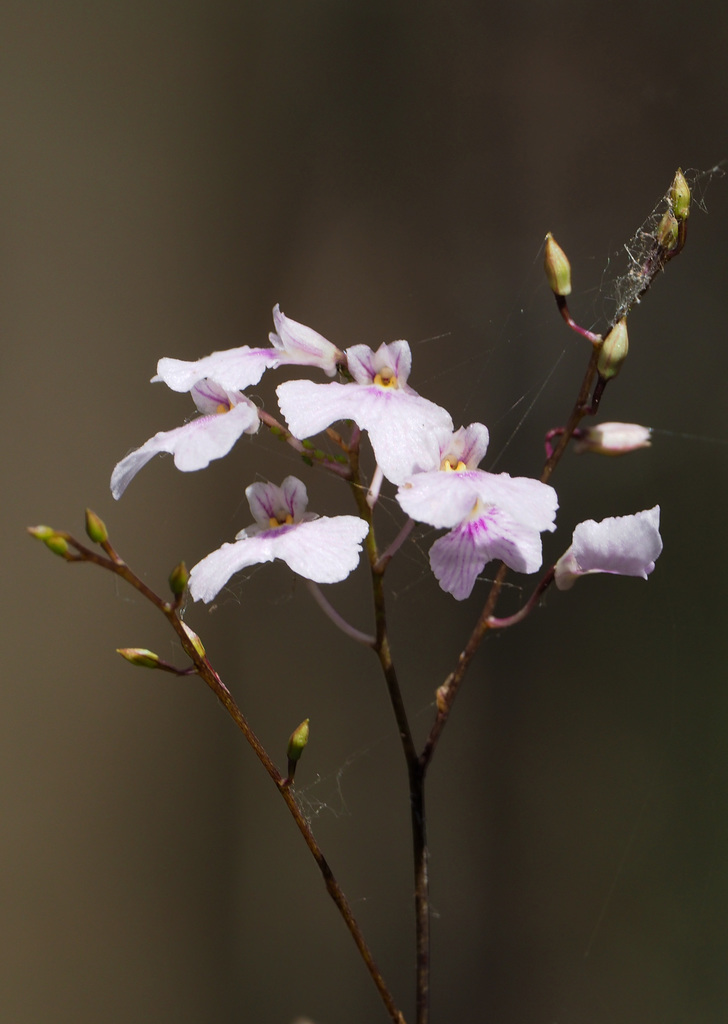
Photo: © Judy Gallagher, CC BY-SA, via iNaturalist
This is the one we can't stop talking about, and the one you can bring home.
Name and range. The accepted name is Ionopsis utricularioides (Sw.) Lindl. Swartz first described it in 1788 as Epidendrum utricularioides, and Lindley moved it to Ionopsis in 1826 (Kew POWO). It ranges across tropical America, from southern Mexico through Central America, the Caribbean and northern South America. At the far northern tip of that range sits a small, rare population in Southwest Florida.
Florida status. It is state Endangered (FDACS, Rule 5B-40.0055) and rated highly state-rare. Herbarium specimens collected between 1904 and 1999 come mostly from Collier County, including the Fakahatchee trams, Deep Lake Hammock and the area around Naples, with a few from Lee and Monroe counties (GBIF). Recorded host trees include pond apple, pop ash and, charmingly, citrus.
What it looks like. A small plant, usually under 15 cm, with a handful of thick, stiff, channeled leaves. Then it does something out of all proportion to its size: a branched inflorescence up to 50 cm long carrying as many as 75 pale pink flowers with darker rose veins (Go Orchids). In Florida it blooms December through April, putting on its show in the dry season when little else in the swamp is flowering.
Species Snapshot
- Plant size: usually under 15 cm
- Inflorescence: branched, up to 50 cm, up to 75 flowers
- Flowers: pale pink with darker rose veins
- Florida bloom season: December–April
- Habit: twig epiphyte of hammocks, sloughs and cypress domes
- Florida status: state Endangered
A twig specialist. In the wild, Ionopsis lives on small branches and outer twigs, usually near standing water. That habitat is the key to its care:
- Mount it. A small cork slab, tree-fern plaque or twig mount, never a pot of bark. Its roots want to dry quickly and then be wetted again.
- Give it steady humidity and strong air movement. The AOS and the South Florida Orchid Society both emphasize "very good air circulation and high humidity year round." A screened lanai near other plants, or a greenhouse with fans running, does the job.
- Use a little more shade than for Tolumnia. Bright filtered light, not full sun.
- Water and feed year-round. It doesn't want a hard winter rest. A small mount in Florida summer heat dries fast, so check it every day.
- Keep it warm. It's happiest with days around 80–85°F and a night drop of about 15°F (AOS). Here in Ocala's Zone 9, it belongs in the greenhouse or indoors during winter cold snaps, not out on the oak tree.
- Watch for pests. Mites and scale are the usual problems, especially in stagnant air.
Lady Vanda Quick Tip
Days 80–85°F · Night drop ~15°F · Humidity high, year-round · Air movement constant · Mount: small cork or twig · Bring it in when Ocala calls for a cold front
A note on lifespan. Many growers find twig epiphytes like Ionopsis can be short-lived in cultivation. We couldn't verify that in the scientific literature, so treat it as grower experience rather than established fact. What does help is keeping a vigorous plant happy on the right mount rather than moving it around.
Grow a Florida Native on Your Own Lanai
Our Ionopsis utricularioides are blooming-size plants, and they're one of the most rewarding miniatures in the collection: a spray of dozens of rose-veined flowers from a plant that fits in your palm.
- Nursery-grown, never collected from Florida's swamps.
- Blooming size or previously bloomed.
- Care support from growers who keep this species on their own benches.
Florida's Terrestrial Orchids
Not every Florida orchid lives in a swamp. The terrestrials grow statewide, including in North and Central Florida, and they're easy to miss unless you're looking at your feet in a wet pine flatwood in spring.
- Grass-pinks (Calopogon). The flowers are "upside down," with the bearded lip on top, and the lip works as a trap door that drops visiting bees onto the pollen. Calopogon multiflorus is state Threatened.
- Fringed and rein orchids (Platanthera, Habenaria). Including the brilliant orange yellow-fringed orchid (P. ciliaris) and the white-fringed orchid (P. blephariglottis), both Threatened. P. chapmanii and P. integra are Endangered.
- Ladies'-tresses (Spiranthes). Spiraled spikes of small white flowers, and one of the most taxonomically tangled genera in the state. Several are Endangered or Threatened.
- Pine-pink (Bletia purpurea). A tall magenta-flowered terrestrial of rocklands and swamp edges; state Threatened.
- Craighead's nodding-caps (Triphora craigheadii). A Florida endemic, found nowhere else on Earth, and critically imperiled (Go Orchids).
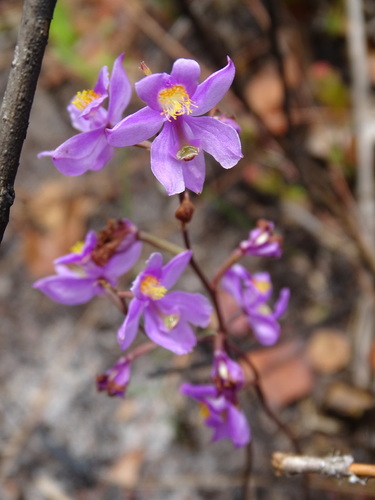
Photo: Michael W Belitz, CC0 (public domain), via iNaturalist
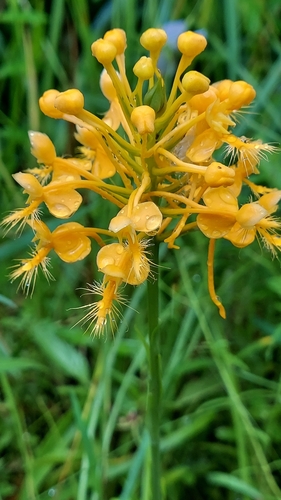
Photo: © Athena Philips, CC BY, via iNaturalist
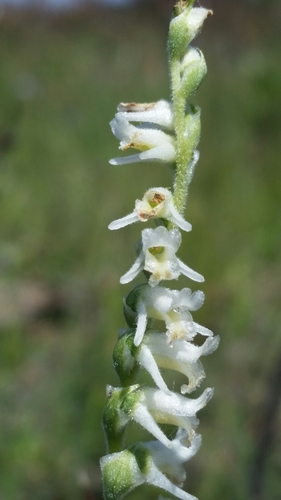
Photo: © Jay Horn, CC BY, via iNaturalist
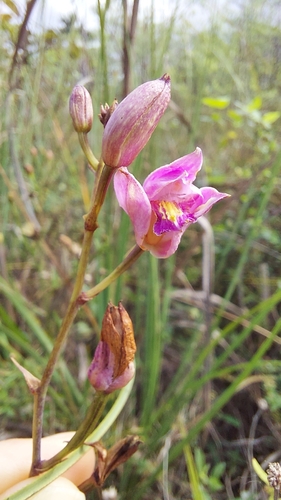
Photo: © Athena Philips, CC BY, via iNaturalist
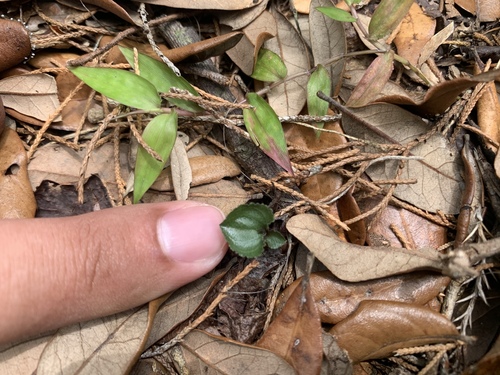
Photo: © Brandon Corder, CC BY, via iNaturalist
A Word on the Invaders
Two non-natives have made themselves at home. The monk orchid (Oeceoclades maculata), from Africa and Madagascar, was first found in Florida in 1974 and self-pollinates its way across hammock floors. The Asian lawn orchid (Zeuxine strateumatica) pops up in turf and potted plants from fall through spring (Go Orchids). If you find either one, you haven't discovered a native rarity.
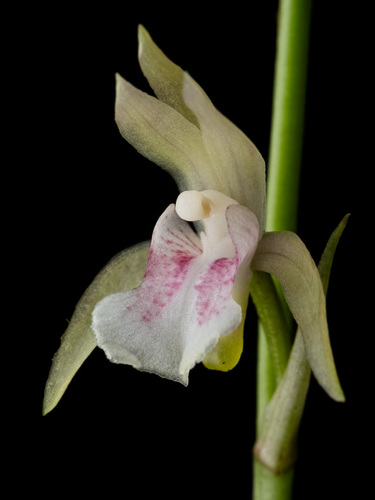
Photo: © Alex Abair, CC BY, via iNaturalist
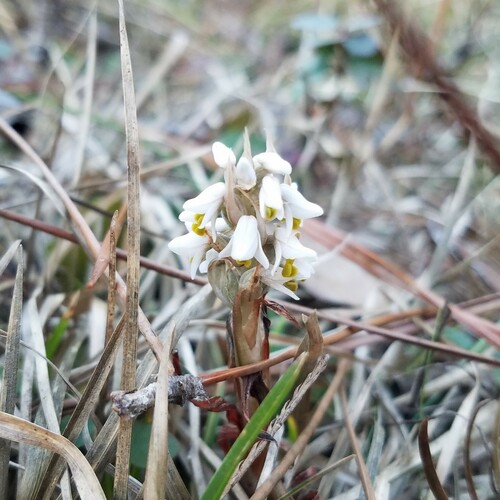
Photo: © Leila Dasher, CC BY, via iNaturalist
Florida's Lost Orchids: Extinct and Extirpated Species
Florida has lost orchids. One species is gone from the planet entirely. At least eight others no longer grow wild in Florida, though several survive elsewhere in the Caribbean. The University of Florida Herbarium's Flora of Florida (Franck, 2026), drawing on status work by the Institute for Regional Conservation, gives the current accounting.
Extinct: Florida Govenia (Govenia floridana)
Globally Extinct
Frank Craighead discovered Govenia floridana in Everglades National Park in 1957, and it was known only from Florida. The last verified sighting was in 1964. Kew assessed the species as Extinct, published on the IUCN Red List in 2022, citing poaching combined with extensive habitat loss (Royal Botanic Gardens, Kew).
The story has loose threads. The Flora of North America records reported sightings in 1990 and a report of four immature plants in 2000, none confirmed, and some botanists question whether G. floridana was truly distinct from a Caribbean or Mexican Govenia. For now, the official status is extinct.
Extirpated From Florida
Gone From the Wild in Florida
These species survive elsewhere in their range but no longer grow wild in Florida:
| Species | Last FL record | Where it grew | Primary cause |
|---|---|---|---|
| Bulbophyllum pachyrachis (now B. pinelianum) | ~1970s | Fakahatchee Central Slough | Collectors |
| Epidendrum acunae | 1962 (one population) | Fakahatchee | Overcollecting |
| Brassia caudata | Late 1970s; some accounts say 1990 | Miami-Dade hammocks, Everglades | Overcollecting; freezes and fires in the late 1960s |
| Macradenia lutescens | Gone by the 1970s | Eastern Everglades hammocks | Overcollecting |
| Vanilla dilloniana | Undated | Paradise Key, Miami River area | Habitat loss and collecting |
| Maxillaria parviflora | Not documented | Collier County swamps | Not documented |
| Trichocentrum carthagenense | Not documented | South Florida | Not documented |
| Spiranthes amesiana | Disputed | South Florida | Taxonomy unsettled: often merged with S. torta, which still has Florida records |
Sources: Franck 2026; Flora of North America; Go Orchids; Friends of Fakahatchee. Where sources disagree on dates, the table notes it.
None of these can be photographed in Florida's wild anymore. Here's what several of them look like where they still survive:
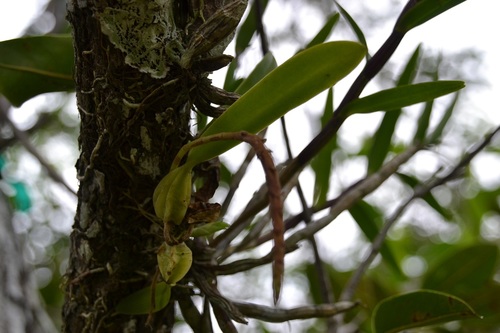
Photo: © Letizia Weichgrebe, CC BY, via iNaturalist
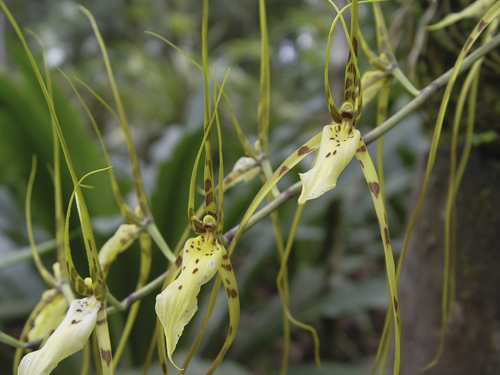
Photo: © Frank Dietze, CC BY, via iNaturalist
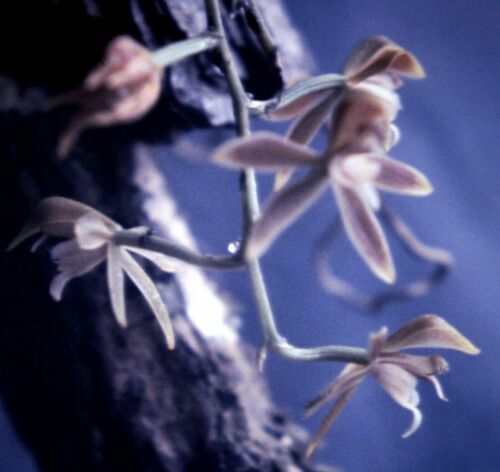
Photo: © maarten sepp, CC BY-SA, via iNaturalist
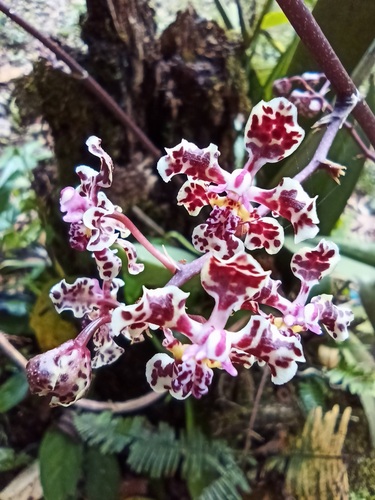
Photo: © Martha Lucia Ortiz-Moreno, CC BY, via iNaturalist
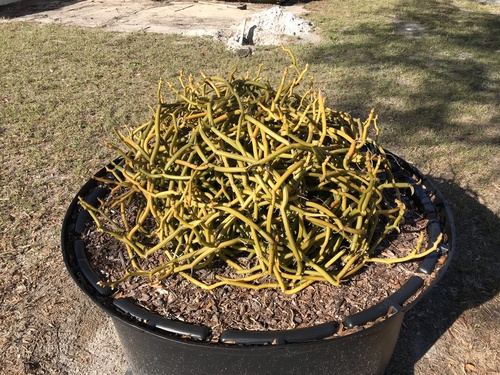
Photo: © Brandon Corder, CC BY, via iNaturalist
In 2012, a Friends of Fakahatchee team traveled to Cuba and found both Bulbophyllum pachyrachis and Epidendrum acunae growing there, with E. acunae even wild in the Guaniguanico Mountains. Florida's lost orchids still exist. They just don't grow in Florida anymore.
Missing, Presumed… Maybe
- Lepanthopsis melanantha is a tiny orchid known in Florida only from the Fakahatchee, "rarely seen, and sometimes assumed to be extirpated" (Franck, 2026).
- Cranichis muscosa was known from historical Miami-Dade and Lee County sites that Carlyle Luer couldn't relocate in 1972. It was later rediscovered in the Fakahatchee after almost a century without a Florida record (Go Orchids), a good reminder that "not seen" doesn't always mean "gone."
- Ponthieva brittoniae is hanging on, but most of its Miami-Dade habitat "has succumbed to urbanization" (Flora of North America).
- Basiphyllaea corallicola has been sighted only a handful of times since its discovery in 1903.
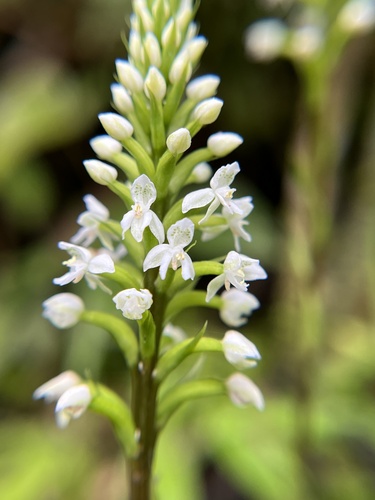
Photo: © Matthew Sirotkin, CC BY, via iNaturalist
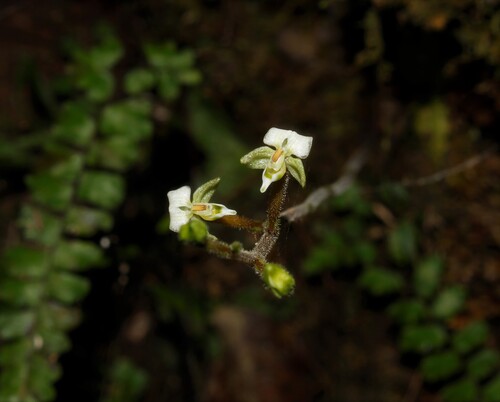
Photo: © J. L. Gómez-Hechavarría, CC BY, via iNaturalist
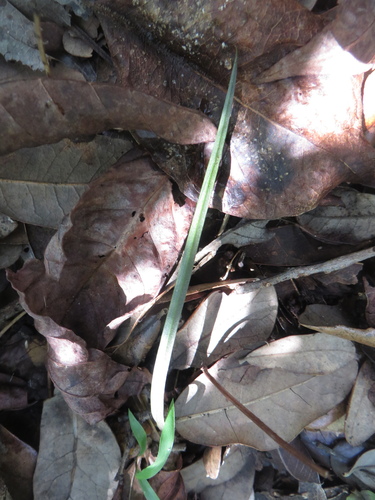
Photo: © Ben Machado, CC BY, via iNaturalist
Why Florida's Orchids Disappeared
When a species vanishes, it's tempting to blame one thing. The record shows several pressures stacking up over time.
- Commercial collecting: the primary cause. UF/IFAS notes that orchids were "among the first of Florida's natural resources to be exploited, harvested for sale to the point of near extinction." Fairchild Tropical Botanic Garden describes Miami-area orchids a century ago being "harvested by the ton for commercial markets." The National Park Service says collecting "is believed to have directly led to the extirpation of at least three orchid species" in Everglades National Park alone. Nearly every species in the table above was a single-population rarity within reach of people who knew what it was worth.
- Logging and drainage opened the swamps. The Lee Tidewater Cypress Company bought the Fakahatchee in 1913 and, from 1944 to 1954, logged it at roughly one million board feet of cypress per week, laying miles of tram roads to haul the timber out (Florida State Parks; Friends of Fakahatchee). Drainage canals dug for 1960s real estate development dried it further. According to the Friends of Fakahatchee, deep water and tall canopy had protected the rarest orchids until the logging era, and the trams then gave collectors access to places that had been nearly unreachable.
- Urbanization of the Miami rocklands and hammocks. South Florida's tropical hammocks and pine rocklands sat on the same high ground people wanted to build on. Macradenia, Brassia and Ponthieva brittoniae lost most of their habitat to development.
- Freezes, fires and hurricanes. On their own, these rarely eliminate a healthy population. They finish off one that's already been reduced. Brassia caudata took freezes and fires in the late 1960s after decades of collecting. Drained swamps lose their thermal buffer, which makes freeze damage more likely (USFWS). Hurricane Irma in 2017 opened canopies and battered the last US mule-ear orchids. At Florida Panther National Wildlife Refuge, a monitored population of the leafless ribbon orchid Campylocentrum pachyrrhizum fell from 103 plants to 44 between 2016 and 2022, with the largest single drop in the Irma year (Herdman et al., 2023).
- Poaching continues today. Ten ghost orchids were removed from the Fakahatchee between 2005 and 2020 (USFWS), and the cigar orchid and Tolumnia are still taken illegally.
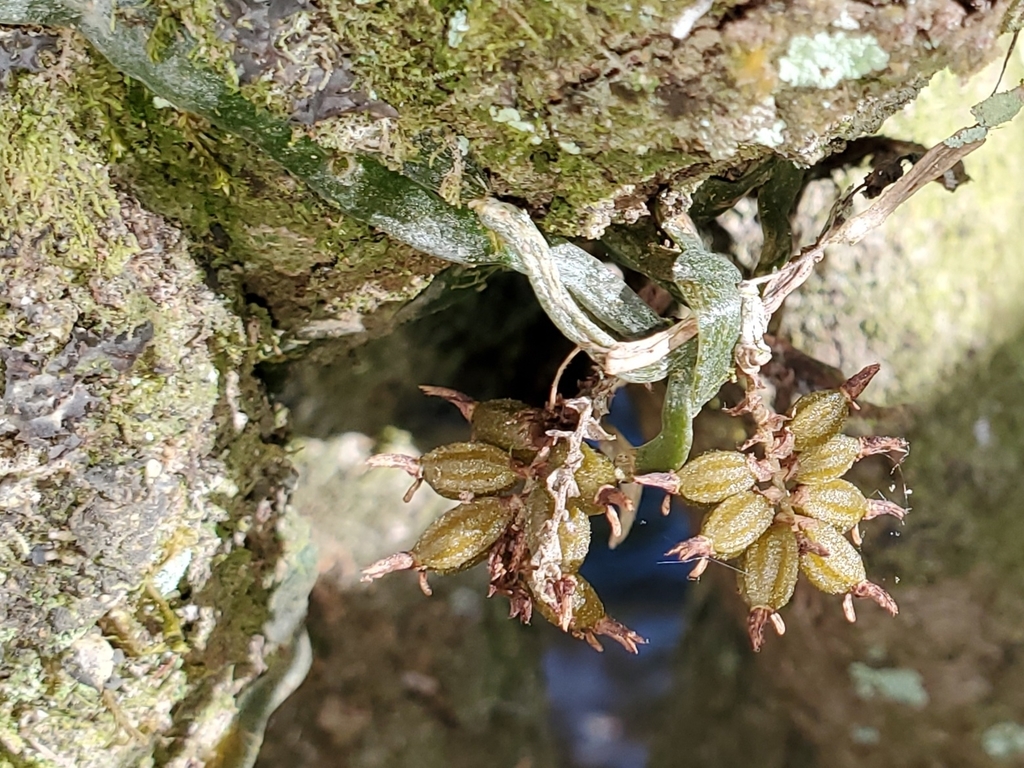
Photo: © Laura Gaudette, CC BY, via iNaturalist
The rarest orchids in Florida weren't lost to a bad winter. They were lost because they were small, isolated populations, and people took them.
Is It Illegal to Collect Wild Orchids in Florida?
In almost every real-world case, yes. Under Florida Statute 581.185:
- Endangered species (like Ionopsis, the clamshell and the cigar orchid): removing them from land you don't own requires the landowner's written permission plus an FDACS permit.
- Threatened species: the landowner's written permission.
- Commercially Exploited species (like the Tampa butterfly and green-fly orchids): landowner permission, plus a permit for three or more plants.
State parks, national parks and national preserves prohibit removing any plant, so a permit won't help you there. All orchids are also covered internationally under CITES Appendix II, which regulates cross-border trade.
Lady Vanda Quick Tip
The legal way to own Florida native species is to buy nursery-propagated plants from a licensed grower. Florida law specifically allows licensed nurseries to sell plants they've propagated.
How Species Collectors Can Help
- Buy propagated, never wild-collected. Ask sellers where their plants come from. A reputable nursery will tell you.
- Photograph, don't pick. Share sightings on iNaturalist or with your local native plant society. Occurrence records help scientists track populations.
- Keep exact locations private. Found a rare orchid in the wild? Don't post the GPS coordinates.
- Support the people doing the work. The Friends of Fakahatchee, the Institute for Regional Conservation and Fairchild Tropical Botanic Garden's orchid reintroduction programs are putting lab-grown seedlings back into Florida's trees.
Frequently Asked Questions
How many orchids are native to Florida?
Roughly 106 to 118 native species and varieties, depending on the source and how varieties are counted. That's about half of the orchid species in the continental US.
What is the rarest orchid in Florida?
Among orchids still growing wild, the leading candidates are the mule-ear orchid (a single US population), Lepanthopsis melanantha (possibly extirpated) and the endemic Triphora craigheadii. The ghost orchid is the best known, with fewer than 1,000 plants in the US.
Are any Florida orchids extinct?
Yes. Govenia floridana, a Florida endemic, is assessed as extinct, with its last verified sighting in 1964. At least eight other native species, including Bulbophyllum pachyrachis and Epidendrum acunae, have been extirpated from Florida but survive elsewhere.
Why did Florida's orchids go extinct?
Mostly commercial overcollecting, combined with logging, drainage and urban development of their habitats. Freezes, fires and hurricanes then finished off populations that were already small.
Can I grow Florida native orchids at home?
Yes, as long as the plants are nursery-propagated. Ionopsis utricularioides, Encyclia tampensis and the Florida Tolumnia all do well mounted in a humid, bright, airy spot. Our delicate Ionopsis is a good place to start.
Sources
American Orchid Society, Ionopsis · South Florida Orchid Society, Ionopsis · Atlas of Florida Plants, Orchidaceae · Atlas of Florida Plants, Ionopsis utricularioides · Royal Botanic Gardens, Kew, POWO: Ionopsis utricularioides · Royal Botanic Gardens, Kew, Confirming Extinction · Franck, A.R. (2026), Flora of Florida, UF Herbarium · Flora of North America, Govenia floridana · Go Orchids, North American Orchid Conservation Center, Species pages · UF/IFAS Gardening Solutions, Florida's Native Orchids · Fairchild Tropical Botanic Garden, Florida Orchids · Friends of Fakahatchee, Orchids · Friends of Fakahatchee, Lost and Found in Cuba, Pt. 5 · Florida State Parks, History of Logging in the Fakahatchee · FNAI, Encyclia tampensis Field Guide · FDACS, Rule 5B-40.0055, Regulated Plant Index · Florida Statutes, § 581.185 · USFWS (2025), Ghost Orchid Proposed Endangered Status, Federal Register · Houlihan, P.R. et al. (2019), Pollination ecology of the ghost orchid, Scientific Reports 9: 12850 · Herdman, A.R. et al. (2023), Campylocentrum pachyrrhizum in Florida, Diversity 15(4): 576 · National Park Service, Everglades Orchids · Florida International University, Saving Mule-Ear Orchids · Naples Botanical Garden, Florida native orchids · GBIF, Ionopsis utricularioides occurrence records · Brown, P.M. Wild Orchids of Florida, University Press of Florida
Photo credits: All photographs are used under Creative Commons licenses (CC BY, CC BY-SA or CC0) from iNaturalist, credited beneath each image. Licenses as stated on each photo's iNaturalist page. Photos were not modified beyond display cropping.


